Parallel Proof-of-Work with Concrete Bounds: A New Family of State Replication Protocols
Analysis of a novel parallel proof-of-work blockchain protocol offering concrete security bounds, faster finality, and robustness against double-spending attacks.
Home »
Documentation »
Parallel Proof-of-Work with Concrete Bounds: A New Family of State Replication Protocols
1. Introduction & Overview
This paper, "Parallel Proof-of-Work with Concrete Bounds," addresses a fundamental limitation in blockchain consensus: the probabilistic and asymptotic nature of security in traditional Proof-of-Work (PoW) systems like Bitcoin. While Nakamoto consensus revolutionized decentralized trust, its security arguments have largely been heuristic or asymptotic, leaving users uncertain about the exact waiting time required for transaction finality. This uncertainty is exploited by threats like double-spending and selfish mining.
The authors, Patrik Keller and Rainer Böhme, propose a paradigm shift from sequential PoW (where each block references one previous puzzle) to parallel PoW. Their protocol family uses $k$ independent puzzles per block, enabling a bottom-up design from a robust agreement sub-protocol. The primary contribution is the derivation of concrete, non-asymptotic bounds for the failure probability in adversarial synchronous networks. A showcased instance with $k=51$ puzzles achieves a failure probability of $2.2 \cdot 10^{-4}$ for consistency after one block, a dramatic improvement over optimized sequential PoW.
2. Core Protocol & Technical Framework
The protocol is constructed from first principles, building upon established models from sequential PoW literature but diverging in its core mechanics.
2.1. Sequential vs. Parallel PoW
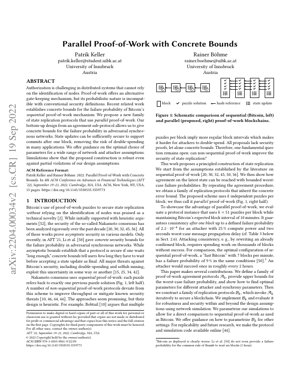
The key architectural difference is visualized in the paper's Figure 1. Sequential PoW (Bitcoin) creates a linear chain where each block's hash is the solution to a single puzzle referencing the previous block. Parallel PoW (Proposed) creates a block containing $k$ independent puzzle solutions. This structure decouples the rate of agreement opportunities from the block creation rate.
2.2. The Agreement Sub-Protocol Ak
The foundation is an agreement protocol $A_k$ for the latest state. Honest nodes attempt to solve $k$ independent puzzles in parallel. Agreement on a new state is reached based on a threshold of solved puzzles within the network. This sub-protocol is then repeated to form a full state replication protocol, inheriting the concrete error bounds of the agreement step.
2.3. Security Model & Adversarial Assumptions
The analysis assumes a synchronous network with a known worst-case message propagation delay $\Delta$. The adversary controls a fraction $\beta$ of the total computational power. The model considers an adversary that can deviate arbitrarily from the protocol but is constrained by its computational share and network synchrony.
3. Concrete Security Analysis
The paper's major contribution lies in moving from asymptotic to concrete security guarantees.
3.1. Deriving Failure Probability Bounds
The authors provide upper bounds for the worst-case failure probability (e.g., a consistency violation). The probability that an attacker can successfully fork the chain or double-spend is expressed as a function of key parameters: number of puzzles per block ($k$), attacker's relative power ($\beta$), network delay ($\Delta$), and the honest network's puzzle-solving rate ($\lambda$). The bound takes a form reminiscent of tail bounds in probability theory, leveraging the parallel structure to tighten the guarantees significantly compared to a sequential chain.
3.2. Parameter Optimization Guidance
The paper offers practical guidance for choosing $k$ and the block interval to minimize the failure probability for a given set of network conditions ($\Delta$, $\beta$). This transforms protocol design from a heuristic exercise into an optimization problem with quantifiable objectives.
Exemplary Configuration & Bound
Target: Consistency after 1 block (fast finality). Parameters: $k=51$, $\beta=0.25$ (25% attacker), $\Delta=2s$. Result: Failure Probability $\leq 2.2 \times 10^{-4}$. Interpretation: An attacker would need to attempt thousands of blocks for one successful consistency attack.
4. Experimental Results & Performance
4.1. Simulation Setup & Robustness Tests
The proposed construction was evaluated through simulations designed to test robustness. The simulations intentionally violated some of the strict design assumptions (e.g., perfect synchrony) to assess the protocol's behavior in more realistic, "messy" network conditions. The results indicated that the protocol remained robust even with partial violations, suggesting the theoretical bounds are conservative and the design is practically resilient.
4.2. Key Performance Metrics
The primary comparison is against an optimized "fast Bitcoin" configuration (sequential PoW with a much shorter block interval) aiming for similar latency. As cited from Li et al. (AFT '21), such a sequential protocol has a failure probability of ~9% under comparable conditions ($\beta=0.25$, $\Delta=2s$). The parallel PoW protocol reduces this by over two orders of magnitude to $2.2 \times 10^{-4}$, demonstrating its superior ability to provide fast, secure finality.
Key Insights
Concrete over Asymptotic: Provides users with a calculable waiting time for finality, eliminating guesswork.
Fast Finality: Enables secure single-block confirmation for many applications, effectively removing the double-spending risk window present in Bitcoin.
Parameter-Driven Design: Security becomes a tunable parameter based on measurable network properties.
5. Comparative Analysis & Insights
Industry Analyst Perspective
5.1. Core Insight
Keller and Böhme aren't just tweaking Bitcoin; they're fundamentally re-architecting the trust foundation of PoW blockchains. The core insight is that security latency (time to finality) is not inherently tied to block production latency. By parallelizing the "work" within a block, they decouple these two variables. This is a more profound innovation than simply increasing block size or frequency, as it attacks the root cause of probabilistic finality. It's akin to moving from a single, slow, ultra-reliable processor to a array of faster, slightly less reliable ones, and using voting mechanisms (the agreement sub-protocol $A_k$) to achieve higher net reliability and speed—a concept seen in fault-tolerant computing systems like RAID or Byzantine Fault Tolerance (BFT) clusters, but now applied to cryptographic puzzles.
5.2. Logical Flow
The paper's logic is impeccably bottom-up and defense-first: 1) Identify the Weak Link: Asymptotic security is insufficient for real-world finance (citing Li et al.'s concrete bounds work as a catalyst). 2) Isolate the Primitive: Focus on the agreement sub-protocol, not the whole chain. This is smart—it reduces complexity. 3) Re-engineer the Primitive: Replace the single-puzzle race with a multi-puzzle threshold agreement. 4) Quantify Everything: Derive concrete bounds for this new primitive. 5) Compose Security: Show that repeating the secure primitive yields a secure chain. This flow mirrors rigorous security engineering in other fields, such as the provable security approach in modern cryptography (e.g., the work of Shoup and Bellare-Rogaway on security proofs).
5.3. Strengths & Flaws
Strengths: The concrete bounds are a game-changer for enterprise adoption. CFOs can now audit a blockchain's security like a financial model. The performance numbers are compelling—a failure probability of $2.2 \times 10^{-4}$ vs. 9% is not an incremental improvement; it's a different risk class. The parameter guidance turns protocol design from art to science.
Flaws & Caveats: The synchronous network assumption is its Achilles' heel. While simulations show robustness to mild asynchrony, the worst-case bounds depend on a known $\Delta$. In the real world, network delays are variable and can be manipulated (e.g., via BGP hijacking). The protocol also increases per-block communication complexity by a factor of $k$ (solutions to broadcast). For $k=51$, this is non-trivial. Finally, while it mitigates double-spending brilliantly, the analysis seems focused on consistency; other attacks like transaction censorship or selfish mining in this parallel model need deeper exploration.
5.4. Actionable Insights
For blockchain architects: This paper provides a blueprint for building high-assurance, fast-finality PoW chains for specific use cases (e.g., institutional settlement, gaming assets) where network conditions can be bounded or over-provisioned. The $k=51$ example is a starting point, not a universal optimum.
For investors & analysts: View any "high-speed PoW" chain claiming fast finality with skepticism unless it offers similar concrete bounds. This work sets a new benchmark for security claims.
For researchers: The biggest opportunity is to hybridize this approach. Can we combine parallel PoW's concrete bounds with a fallback to a slower, asynchronous-safe consensus (like Chainweb's braided PoW or Snowman consensus) to handle network outages? The quest for robust, quantifiable finality is now the central challenge.
6. Technical Details & Mathematical Formulation
The security analysis relies on modeling the puzzle-solving process of honest nodes and the adversary as Poisson processes. Let $\lambda$ be the total hash rate of the honest network, and $\beta\lambda$ be the adversary's rate ($0 < \beta < 0.5$). In the parallel protocol with $k$ puzzles, the honest network's rate for solving any given puzzle is $\lambda/k$.
The core of the bound involves calculating the probability that the adversary can secretly solve a sufficient number of puzzles to create a competing chain that outpaces the honest chain's growth in a given time window, which is a function of the network delay $\Delta$. The parallel structure allows the use of Chernoff-type bounds for binomial/Poisson distributions to tightly limit this probability. The failure probability $\epsilon$ for consistency after one block is bounded by an expression of the form:
$$\epsilon \leq f(k, \beta, \lambda\Delta)$$
where $f$ is a function that decreases exponentially or super-exponentially with $k$ for fixed $\beta$ and $\lambda\Delta$, explaining the drastic improvement over sequential PoW.
7. Analysis Framework: Example Case
Scenario: A consortium blockchain for inter-bank settlement requires transaction finality within 15 minutes with a security failure probability less than $10^{-6}$ per settlement. The network is well-provisioned with a maximum measured delay $\Delta = 1.5$ seconds. Participants estimate a potential attacker could control up to 30% of the compute power ($\beta=0.3$).
Plug into Model: Use the bound $\epsilon \leq f(k, \beta=0.3, \lambda\Delta)$. The honest hash rate $\lambda$ is set to achieve a desired overall block time (e.g., 10 minutes).
Solve for k: Iteratively find the minimum $k$ such that $f(k, 0.3, \lambda\Delta) < 10^{-6}$. The paper's methodology provides the function $f$ and optimization guidance.
Output Protocol Specification: The consortium would deploy the parallel PoW protocol with the derived $k$ (likely >51 for the stricter $10^{-6}$ target) and corresponding block interval.
This framework turns a business requirement into a precise technical specification.
8. Application Outlook & Future Directions
Immediate Applications: The protocol is ideally suited for controlled-environment blockchains where network synchrony is a reasonable assumption. This includes private/consortium chains for financial settlement, supply chain provenance, and enterprise asset tracking. Its ability to provide fast, quantifiable finality is a major advantage over traditional PoW or even some Proof-of-Stake systems subject to long-range attacks.
Future Research Directions:
Partial Synchrony/Asynchrony: Extending the model to partial synchrony (like Dwork-Lynch-Stockmeyer) or asynchronous networks would greatly broaden applicability.
Hybrid Designs: Combining parallel PoW with other consensus mechanisms (e.g., a parallel PoW fast lane with a sequential or BFT finality layer) could offer robust security under varying conditions.
Energy Efficiency: Exploring if the concrete bounds allow for a reduction in total absolute hash power ($\lambda$) while maintaining security, potentially improving energy efficiency compared to "security-through-obscurity-of-hashrate" in Bitcoin.
Formal Verification: The clear mathematical model makes this protocol an excellent candidate for formal verification using tools like Coq or Ivy, as seen in projects like the verification of the CBC Casper consensus protocol.
The work opens a new sub-field: quantitative security engineering for blockchains.
9. References
Keller, P., & Böhme, R. (2022). Parallel Proof-of-Work with Concrete Bounds. In Proceedings of the 4th ACM Conference on Advances in Financial Technologies (AFT '22).
Nakamoto, S. (2008). Bitcoin: A Peer-to-Peer Electronic Cash System.
Li, J., et al. (2021). Bitcoin Security under Temporary Dishonest Majority. In Proceedings of the 3rd ACM Conference on Advances in Financial Technologies (AFT '21).
Garay, J., Kiayias, A., & Leonardos, N. (2015). The Bitcoin Backbone Protocol: Analysis and Applications. In EUROCRYPT.
Pass, R., Seeman, L., & Shelat, A. (2017). Analysis of the Blockchain Protocol in Asynchronous Networks. In EUROCRYPT.
Dwork, C., Lynch, N., & Stockmeyer, L. (1988). Consensus in the Presence of Partial Synchrony. Journal of the ACM.
Bellare, M., & Rogaway, P. (1993). Random Oracles are Practical: A Paradigm for Designing Efficient Protocols. In ACM CCS.
Buterin, V., & Griffith, V. (2019). Casper the Friendly Finality Gadget. arXiv preprint arXiv:1710.09437.